Every tool brand on the market claims to be “built for the jobsite.” Every workwear brand says it’s “made for hard-working Aussies.” Every software brand promises to “save tradies time.” The category is drowning in interchangeable claims, and the only brands cutting through are the ones that have figured out how to tell a story tradie audiences actually care about.
This guide breaks down what trade brand storytelling actually looks like in 2026 — and how to weave it through your influencer marketing campaigns so the message lands.
Why Trade Brand Storytelling Matters More Than It Used To
1. The Audience Has Heard Every Claim Already
“Built for tradies” is now a meaningless background hum. The audience tunes it out. The only brand messages that land are the ones backed by a specific, credible, ownable story.
2. Tradies Buy From Brands They Believe In
The trade audience disproportionately gravitates to brands with genuine founder stories, real heritage, or distinctive points of view. The Stanley vs the no-name knock-off isn’t just a quality decision — it’s an identity decision.
3. Story-Driven Content Outperforms Feature-Driven Content
An influencer post that opens with “I’ve been using this for 6 months on jobsites across Sydney” beats one that opens with “Featuring 5Ah battery and brushless motor” every time. Story-first, spec-second is the winning formula.
The Five Trade Brand Story Archetypes That Work
1. The Founder-Was-a-Tradie Story
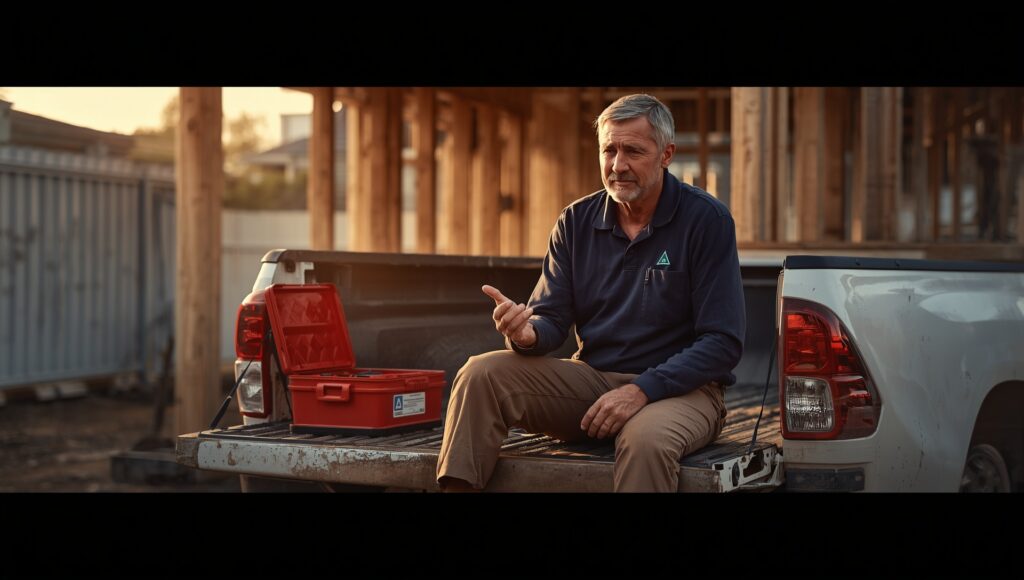
Founder spent 15 years on the tools, got sick of a specific problem, started a brand to fix it. This is the single most powerful trade brand story archetype because the audience instinctively trusts founders who’ve actually done the work.
How to use it in influencer campaigns: Have creators reference the founder story naturally in their integrations. “The bloke who started this brand was on the tools for 20 years before he launched it” carries enormous credibility weight in three seconds of voice-over.
2. The Australian-Made Story
Brand is genuinely Australian designed, owned, or manufactured. In a category dominated by global majors and Chinese white-label, this matters to the audience.
How to use it: Show the factory floor, the design studio, the warehouse, the people. Use creator content to document the supply chain visibly.
3. The Family-Run / Independent Story
Brand isn’t a private equity rollup or a global conglomerate. Real people, real decisions, real reinvestment in the trade community.
4. The Specialist Story
Brand only does one thing and does it better than anyone else. Used well, this is enormously powerful in a category dominated by generalist brand portfolios.
5. The Underdog / Challenger Story
Brand is taking on the global majors. Better value, better build, better service, better warranty. Audiences love rooting for the challenger, particularly in tool and equipment categories where the global majors charge a premium.
The Storytelling Mistakes Trade Brands Make
1. Telling Brand-Centric Stories Instead of Customer-Centric Stories
“We’ve been in business for 25 years” is interesting to you. “This brand saved a Brisbane sparky 8 hours a week on quoting” is interesting to the audience. Always translate the brand story into a customer outcome.
2. Trying to Be Everything
“Premium quality at affordable prices for serious tradies and weekend DIY warriors.” That’s not a story. That’s a fence-sit. Pick a lane and own it.
3. Letting Marketing Write the Story Without Talking to the Trade
Brand stories built in marketing-team workshops without real tradie input consistently feel hollow. The story has to land with the audience — not with the brand manager.
4. Inconsistent Storytelling Across Channels
The story on your website should match the story in your creator briefs should match the story in your retail point-of-sale should match the story in your trade press. Inconsistency breaks trust.
How to Brief Story Into a Creator Campaign
The most powerful technique we’ve seen: give the creator the brand story in plain language, then trust them to translate it into their voice.
Example brief insert:
“The brand was founded by a Sydney chippy named Dave who spent 18 years on commercial sites before getting sick of cheap fixings failing on him. He started this brand to make Australian-designed, Australian-tested fixings priced fairly. Everything we make is real-world tested by tradies on real jobsites before it ships. Feel free to mention any of this in your content — but in your own words, not ours.”
Creators almost always weave the story in naturally when they’re trusted to use their own voice.
Combining Story With Spec, Demo, and Proof
Story alone doesn’t close the sale. The winning structure is layered:
- Hook: A story moment that earns attention (10 seconds)
- Spec: The genuine product differentiators (15 seconds)
- Demo: Real-world use on a real jobsite (30 seconds)
- Proof: A specific number, outcome, or comparison (10 seconds)
- CTA: Where to buy and what to do next (5 seconds)
That 70-second structure consistently outperforms either pure-story or pure-spec content.
Trade Brand Storytelling Beyond Sponsored Content
Your influencer campaigns are only one part of the storytelling system. Audit your full storytelling surface:
- Website “about” page
- Product page copy and visuals
- Retail point-of-sale materials
- Trade press placements and bylined content
- Social media brand-account content
- Email marketing copy and templates
- Customer service responses and tone
- Trade show stand design and signage
- Recruitment and employer brand content
Story consistency across all of the above multiplies the impact of every individual touchpoint.
Build a Story-Led Trade Brand Programme
AuziTrade Collective helps Australian trade brands surface, sharpen, and amplify the story tradie audiences will actually engage with. We work the story into every creator brief, every campaign rollout, and every reporting cycle.
Book a free strategy call or visit our For Brands page.
Built by tradies. For trade brands.